

FEthink Response Introduction Britain’s NEET crisis is no longer a warning sign; it is a structural failure. The latest Office for National Statistics (ONS) bulletin estimates that 1,012,000 young people aged 16 to 24 were Not in Education, Employme...
Read More

Our Work Readiness Audit Framework Explained
Work Readiness - An evidence-informed approach
The FEthink Work Readiness Audit was developed in June 2026 and brings together national policy, research and established frameworks for careers, employability and preparation for work.
We synthesised evidence from sources including the Milburn Review, Gatsby Benchmarks, Careers & Enterprise Company, Skills Builder, CDI, ETF research and academic studies of work readiness and career adaptability. We also drew on the expertise of our FEthink consultants and the education inspection framework for specific criteria on FE process and delivery,
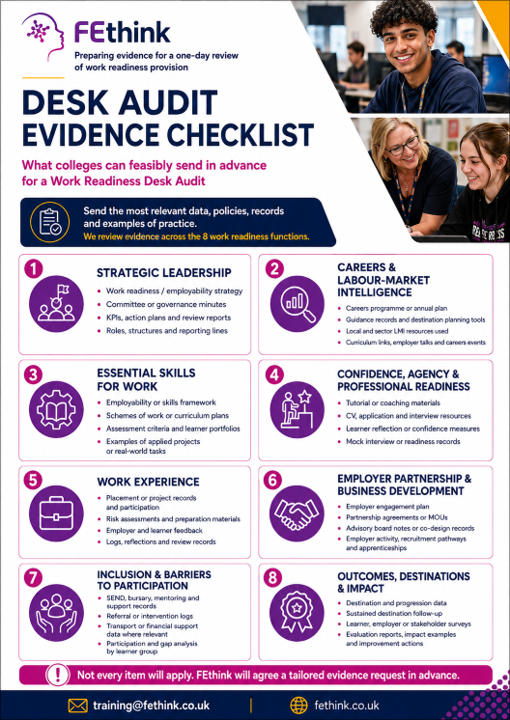
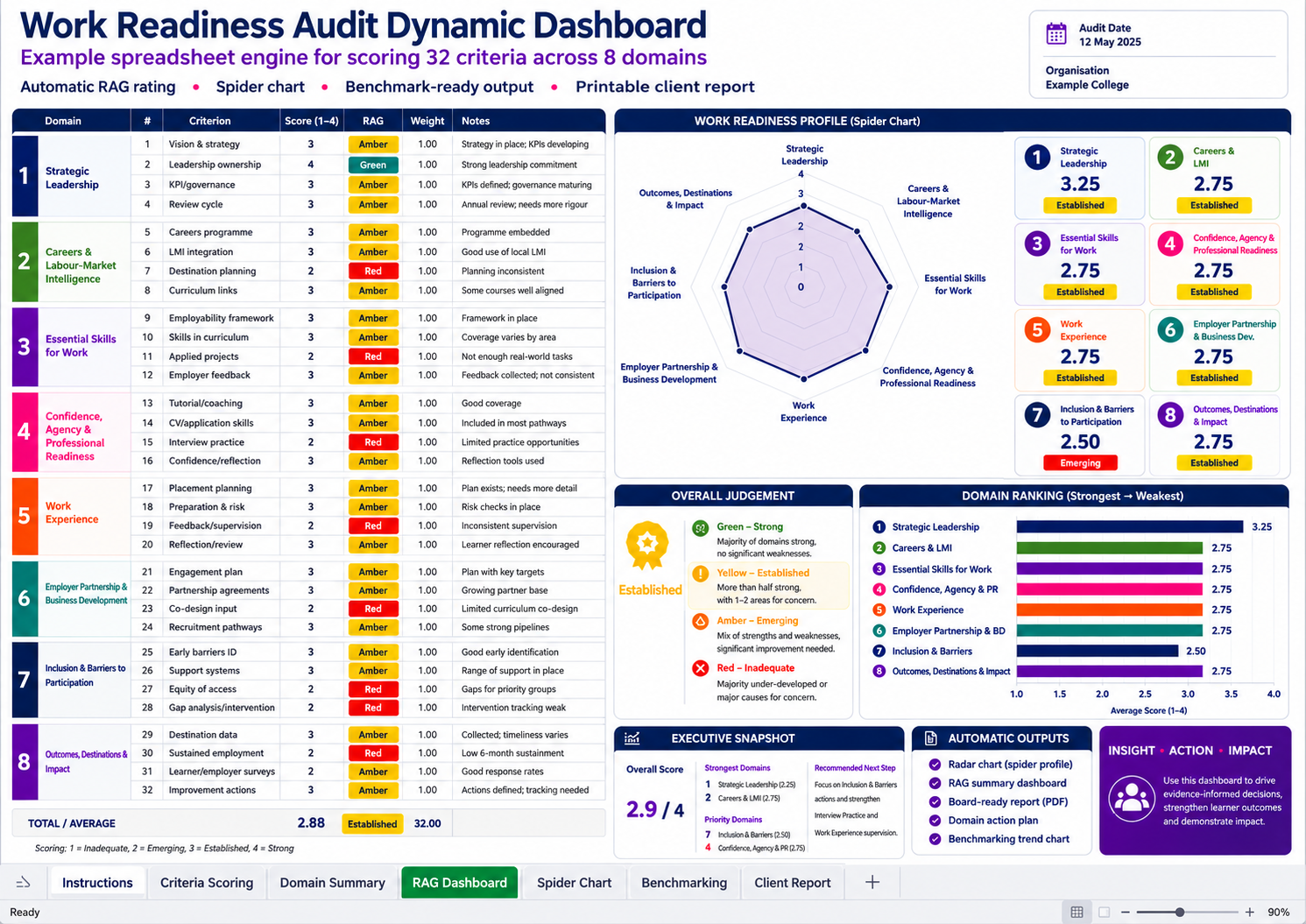
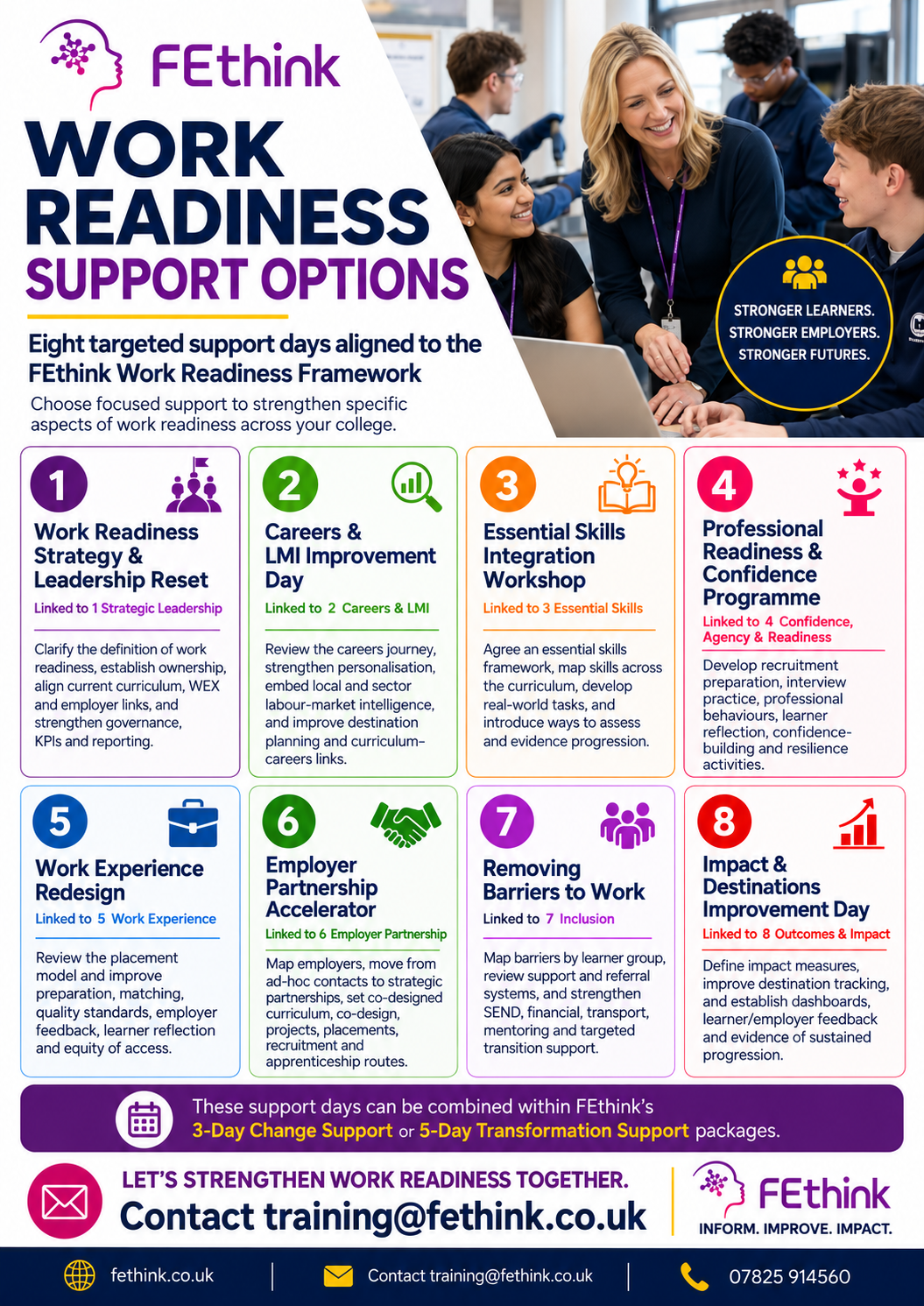
From this evidence, we identified the recurring characteristics of strong provision — including strategic leadership, employer engagement, essential skills, equitable access, meaningful workplace experience and measurable outcomes. These were translated into 32 evidence-led criteria across eight domains, creating a practical framework for diagnosing strengths, identifying gaps and targeting improvement.
How the competencies were formulated
The 32 competencies were developed through structured synthesis rather than adopted from any single framework. We compared the recurring expectations, constructs and indicators across the evidence base, identifying areas of convergence and grouping these into eight coherent domains of work readiness. Each domain was then translated into four assessable competencies describing the organisational conditions, learner experiences or practices that should be observable in effective provision. We deliberately removed duplication between frameworks, converted broad principles into evidence that could be tested through an audit, and retained distinctions between skills, careers knowledge, professional confidence, workplace experience, employer engagement, inclusion and outcomes. The result is a framework designed to connect research and policy expectations with practical organisational improvement.

Work readiness has become a priority inspection area

Improving opportunity for young people


Book an Audit
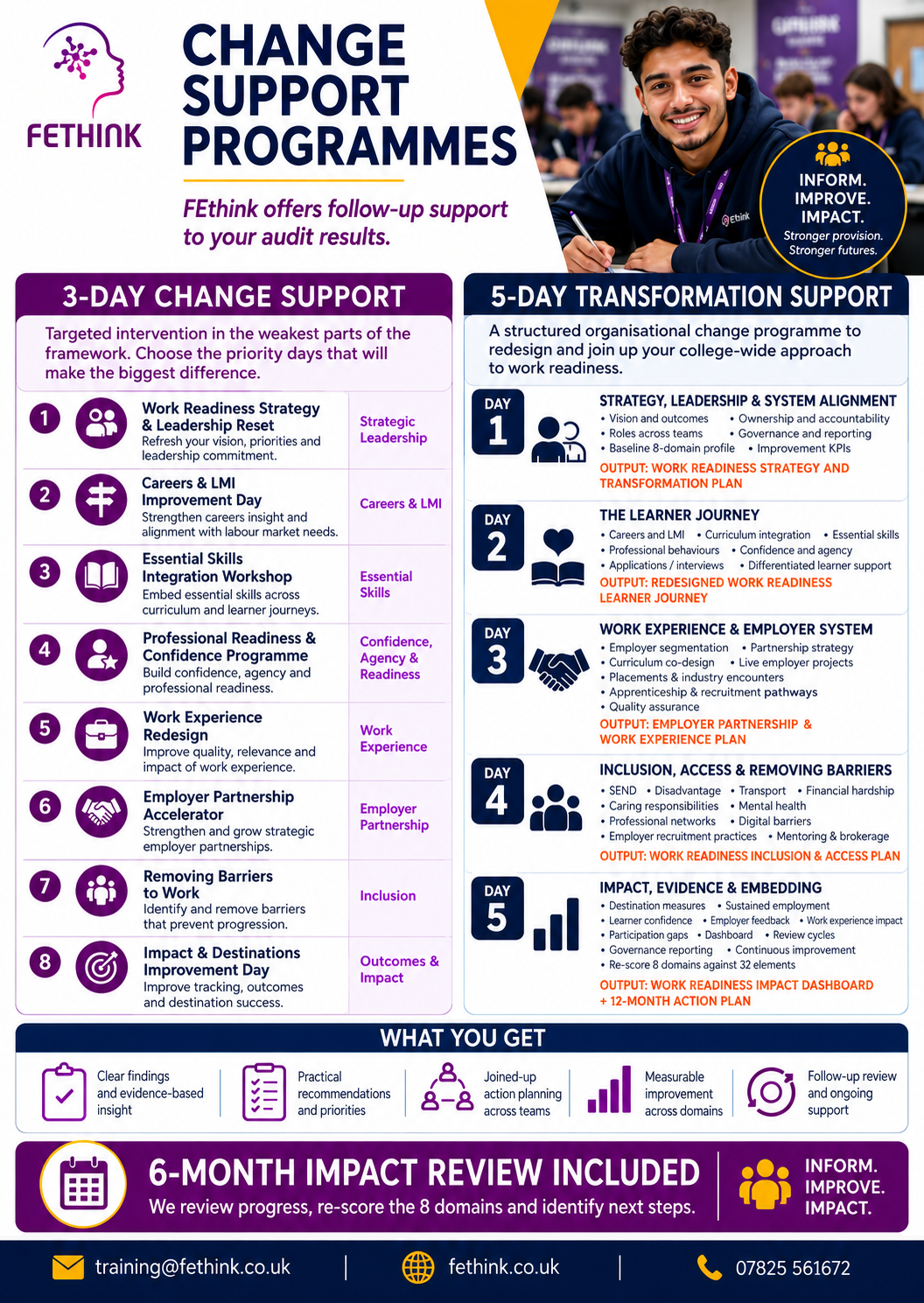
Desk review and onsite Deep Dive audits pinpoint your current work readiness status and provide a roadmap to excellence.
References
Caballero, C. L., Walker, A., & Fuller-Tyszkiewicz, M. (2011). The Work Readiness Scale (WRS): Developing a measure to assess work readiness in college graduates. Journal of Teaching and Learning for Graduate Employability, 2(1), 41–54. https://doi.org/10.21153/jtlge2011vol2no1art552 Deakin University OJS
Why it matters: A valuable academic investigation that establishes work readiness as a multidimensional construct, encompassing personal characteristics, organisational acumen, work competence and social intelligence.
Career Development Institute. (2021). Career development framework: Supporting learners to improve their career development skills. The CDI
Why it matters: Provides six established areas of career development: growing throughout life, exploring possibilities, managing career, creating opportunities, balancing life and work, and seeing the big picture. The CDI framework was launched in April 2021. The CDI
Department for Education, Department for Work and Pensions, & Department for Science, Innovation and Technology. (2025). Post-16 education and skills white paper. HM Government. GOV.UK
Why it matters: Directly establishes the policy expectation for a skills system connected to employers, labour-market demand, practical experience, progression into employment, essential skills, inclusion and support for young people at risk of becoming NEET. GOV.UK
Department for Work and Pensions. (2026). Young people and work: Interim report. HM Government. GOV.UK
Why it matters: The Milburn review provides powerful contemporary evidence concerning the transition between education and employment. It identifies nearly one million 16–24-year-olds as NEET and examines the barriers preventing young people from learning or earning. GOV.UK
Department for Work and Pensions. (2026). Survey of education professionals: Young people and work report (Ad hoc research report No. 141). HM Government. GOV.UK
Why it matters: This survey examines education professionals' views of how effectively education prepares young people for future work. It was based on 1,004 teachers and education professionals and formed part of the evidence assembled for the Milburn review. GOV.UK
Gatsby Charitable Foundation. (2024). Good career guidance: The next ten years.
Why it matters: The updated Gatsby Benchmarks provide the established framework for high-quality careers provision, including stable careers programmes, LMI, individual learner needs, curriculum-career connections, employer encounters, workplace experiences and personal guidance. Gatsby confirms that the benchmarks were updated in 2024 following research, consultation and stakeholder engagement. Gatsby
Savickas, M. L., & Porfeli, E. J. (2012). Career Adapt-Abilities Scale: Construction, reliability, and measurement equivalence across 13 countries. Journal of Vocational Behavior, 80(3), 661–673. https://doi.org/10.1016/j.jvb.2012.01.011 ScienceDirect
Why it matters: This gives us a strong research foundation for the less tangible aspects of readiness. Career adaptability comprises concern, control, curiosity and confidence - resources for navigating occupational transitions and change.
Skills Builder Partnership. (n.d.). The Universal Framework. Skills Builder
Why it matters: Provides a structured progression model for essential transferable skills. The framework identifies eight essential skills and breaks them into measurable developmental steps. Skills Builder
Tanner, E., & Finlay, I. (2021). Future Skills Questionnaire: The development of a tool to measure young people's career-related learning and skills. The Careers & Enterprise Company. CEC Corporate Web
Why it matters: The FSQ was developed specifically to measure career readiness and involved expert consultation, piloting, interviews with Careers Leaders and cognitive testing. The current CEC documentation confirms that it is used to track learner development, identify support needs and evaluate careers provision. CEC Corporate Web
The Careers & Enterprise Company. (2024). Employer Standards for Careers Education - One year on. CEC Corporate Web
Why it matters: Provides an evidence-informed framework for examining the quality and impact of employer engagement, rather than merely counting employer encounters. This supports our Employer Partnerships and Work Experience domains.
