

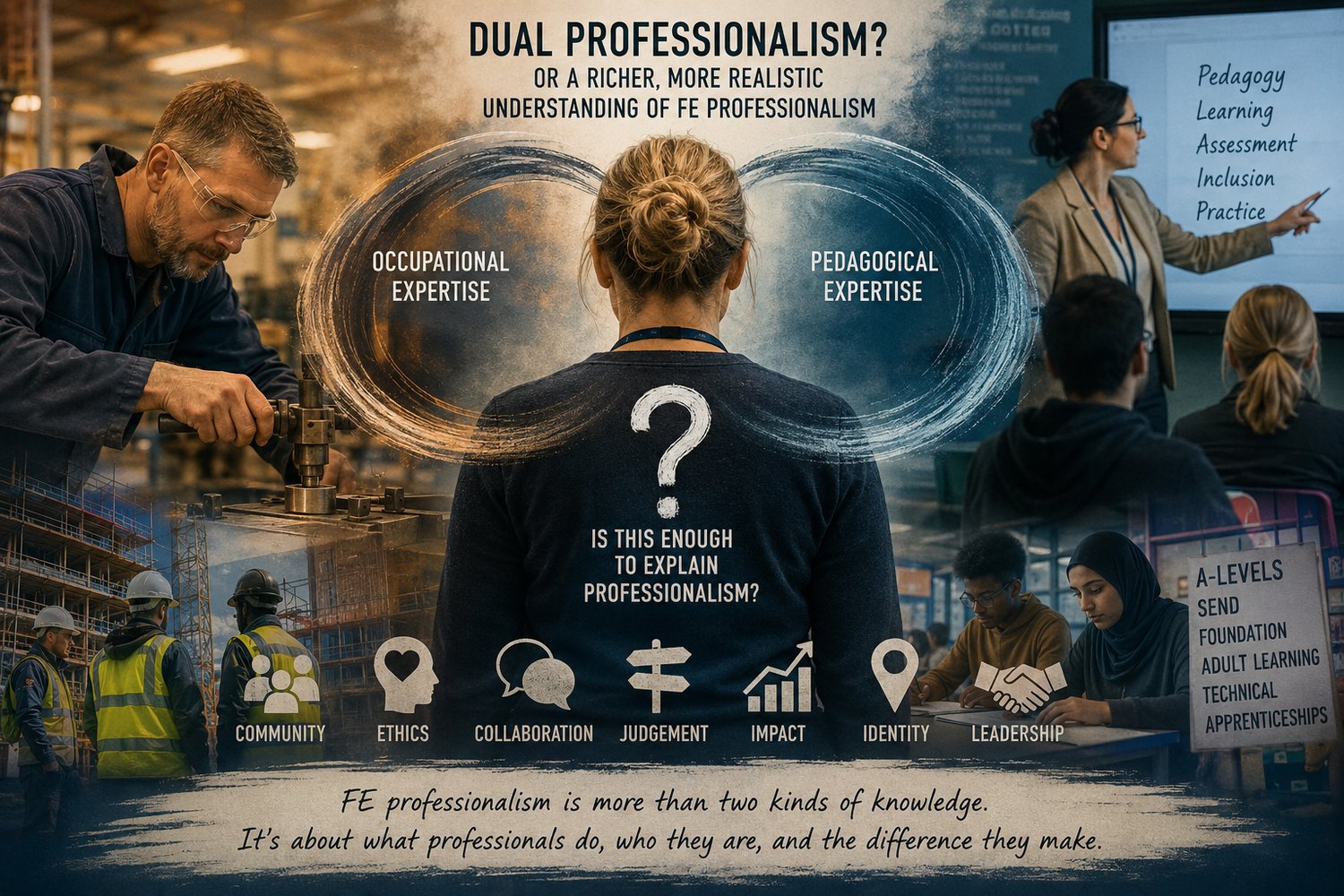
The Education and Training Foundation's (ETF) The Workforce Behind the Workforce seeks to reposition the Further Education (FE) workforce within contemporary debates about economic growth, productivity and skills policy. Drawing upon the view of 2,000 UK adults, the report argues that FE teachers, trainers and leaders constitute the "workforce behind the workforce", whose contribution is insufficiently recognised by policymakers or the public. This blog critically reviews one aspect of the report, the concept of ‘dual professionalism’, described by ETF as “the distinctive professionalism of the FE and skills workforce” (p29) and a “defining characteristic” of technical education (ibid).
Whether technical education, vocational education and further education are interchangeable descriptions for the sector is not confirmed by the report. However, ETF – the sector’s professional body - does agree that “Teaching in FE and skills requires a form of dual professionalism, combining deep occupational knowledge with specialist pedagogical expertise” (p17), so we can presume that dual professionalism is a ubiquitous feature of the FE workforce.
This thinking has been around for at least three decades. Joceyln Robson, in 1998, described a professional duality that existed when industry professionals started a second career in FE teaching. The former Institute for Learning, ETF's predecessor– in the 2000s - popularised the term by explaining the importance of professional development as the basis for enriching teacher professionalism through evidence-based teacher training (see Plowright & Barr, 2012). The Commission on Adult Vocational Technical Teaching and Learning (CAVTL) wrote in 2013 that excellence in vocational pedagogy demanded the 'continuous pursuit' of dual professionalism. The concept has also been the building block of ETF’s T Level professional development programme (2020-2026).
There is no doubt professionalism is a difficult, complex subject to discuss, and public workforce reports such as ETF’s The Workforce Behind the Workforce are not always the obvious place for conceptual debate. At 15 references, however, professionalism is fundamental to this report. FE professionals are repeatedly described as highly skilled, trusted and economically important, and these are positive messages that unite the sector. Dual professionalism is treated as both convention and settled construct, reflecting its dominant – if not stereotypical - status in FE discourse.
However, the concept is deeply flawed and should be dispensed with.
Conceptually, it is simple and is claimed to be unique to the FE sector. Typically, it describes a teacher who combines their prior occupational knowledge (e.g. a plumber) with newly mastered pedagogical skills, to teach a group of learners. Logically, as long as we improve one or both of these knowledge systems, we improve professionalism, even if we don’t know how they interact. However, even a cursory reading of the FE literature shows that professionalism is more than what an individual knows.
If possessing expertise were sufficient alone, it wouldn’t matter if FE teachers practiced in isolation or within a network of peers, but we know this understanding to be incomplete. FE professionalism is also about connection, collaboration and collegiality (Crawley, 2015, 2017; Tully, 2020). The buzz we get from attending a conference isn’t simply about acquiring new information; it is the sense of community and belonging that comes with sharing time and stories with other colleagues, not as knowledge-recipients but as a means of expressing solidarity, wonder, pride and empathy for similar others.
A simple list of questions reveals the concept’s inherent limitations:
- Is compassion, integrity, pride, altruism, fairness and ethicality – the quintessential elements of public service – rooted in a teacher’s pedagogic and/ or disciplinary knowledge frameworks, if at all?
- When a teacher decides to use their personal time to support a learner who is struggling (a situational judgement which entails personal sacrifice), which knowledge system - the pedagogic or the occupational - is driving this decision? How do these knowledge systems inform teacher action or inaction? Is action merely a rational process arising from the evaluation of countless prior 'learning incidents'? Consequently, is 'right' and 'wrong' reducible to learned knowledge patterns? And doesn't this resemble the critiques of AI decision models?
- Is a schoolteacher specialising in geography, biology or English, also a dual professional, or is this label only relevant to FE teachers who have had a prior vocational career? Does this mean A-level teachers cannot be dual professionals?
- What if this geography schoolteacher worked for three years on an architectural site - does this make them a dual professional, despite not working in FE? Are they more of a dual professional than the university neophyte with no work background?
- Does a newly graduated, 22-year-old PGCE-qualified FE teacher in fine art exhibit the same dual professionalism as an experienced gallery curator who has switched to teaching art history after 20 years? Does this imply a difference between subject knowledge and occupational knowledge on professional practice?
- And what of FE leaders who teach? How does dual professionalism explain their role, one in which they might be expected to balance three different knowledge systems - subject knowledge, pedagogic mastery and institutional leadership?
To date, no theorisation of dual professionalism exists to explain these contradictions. At the same time, the concept has become naturalised in FE discourse, a go-to construct whenever professionalism is openly discussed. Yet, despite the enthusiasm of its proponents, the concept has little explanatory power. It is a ‘heroic concept’ because its significance is largely symbolic, akin to a mythology, rather than evidence-informed.
Some allies may argue that dual professionalism only applies to vocational pedagogues transitioning from industry, and isn't designed for other groups of staff. If so, what sort of professionalism do non-vocational colleagues exhibit? And where are the pamphlets, papers and reports that champion this other brand of professionalism? With so many exceptions and unknowns, isn’t it time to ask whether the dual professionalism concept should be retired?
Empirical work (e.g. Tully, 2020; 2022; 2023) suggests professional expertise is only one part of a more complex, inter-relationship with other learner-facing and improvement dimensions of practice shaping professionalism. This work foregrounds identity-formation and a teacher's emerging authority, impact, belonging, pride and status growth. No account of dual professionalism fully captures these elements. Pierre Bourdieu, the great French sociologist, reminds us not to accept dominant concepts uncritically, but to test them against the evidence and remain reflexive about how reality is described. FE is neither exclusively vocational nor exclusively composed of industry experts, both essential components of the construct. It overlooks the fact that a significant part of FE's provision focuses on A-levels, GCSE resits, foundation work, recreational education, independent living courses and SEND classes. This is not to diminish FE’s vital role in preparing learners for work, but it does mean the sector is richer and more diverse than a dual professionalism concept allows for.
In conclusion, dual professionalism is an over-simplified and stereotypical explanation for FE professionalism, when the reality is far messier, richer, dynamic and more conflicting. If we want a framework that reflects the sector as it really is - diverse, relational, vocational, academic, caring and contradictory - then we need models that can account for this complexity and can characterise the tensions that arise from ‘making practice’. Dual professionalism offers almost no intellectual space for understanding why professionalism is ‘contested’ or ‘subject to struggle’, yet researchers consistently agree professionalism is both. Damien Page presents a compelling case study of construction teachers being professionally challenged by the shift from building site to tutorial room, in which the journey towards professionalism is less about knowledge acquisition, and more about identity and status (re-)negotiation. If the FE profession is truly evidence-informed, we cannot continue to defend an out-dated orthodoxy, no matter how seductive. We must develop proper, tested, analytical constructs, and professional bodies must lead this journey.
