


Workforce Capability

Defining workforce capablity
Workforce capability is the collective capacity to perform work effectively, sustain delivery and improve practice.
For FE, that purpose includes high-quality teaching, learner support, effective operations and leadership. The definition therefore covers the whole workforce, including teachers, support staff, managers and leaders.
Capability is to be distinguished from:
Capacity: do we have enough people and time?
Performance: what results are we achieving?
Measuring workforce capability reveals where staffing pressures, gaps in expertise and working conditions may be limiting results, helping leaders target investment and support where they are most needed.
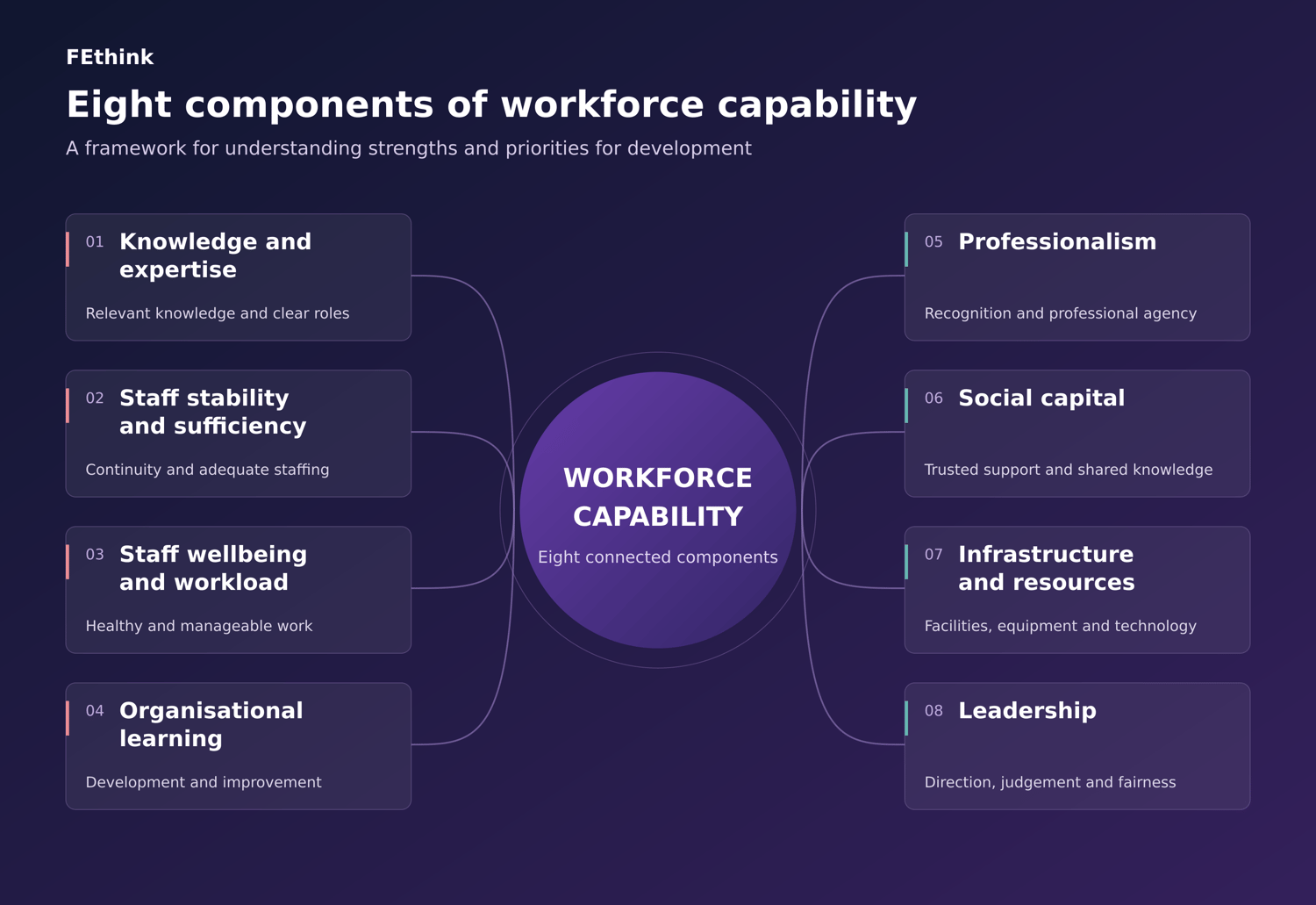
It identifies strengths, pressures and priorities for development, supporting better decisions about staffing, support and investment. Our framework examines eight core elements: knowledge and expertise; staff stability and sufficiency; wellbeing and workload; organisational learning; professionalism; social capital; infrastructure and resources; and leadership. Together, these provide a practical workforce profile.
We distilled these eight components by examining research on professional capital (Hargreaves & Fullan, 2012), wellbeing and work demands (Bakker & Demerouti, 2017), vocational teaching and leadership (OECD, 2021), and FE workforce conditions (Scott et al., 2026). Iterative review clarified boundaries, reduced overlap and identified practical indicators.
References
Bakker, A. B., & Demerouti, E. (2017). Job demands–resources theory: Taking stock and looking forward. Journal of Occupational Health Psychology, 22(3), 273–285. https://doi.org/10.1037/ocp0000056
Supports the relationship between work demands, resources and wellbeing.
Hargreaves, A., & Fullan, M. (2012). Professional capital: Transforming teaching in every school. Teachers College Press.
Provides the conceptual basis for human, social and decisional capital in teaching.
OECD. (2021). Teachers and leaders in vocational education and training. OECD Publishing. https://doi.org/10.1787/59d4fbb1-en
Addresses vocational expertise, professional development, staffing, technology and leadership.
Scott, M., Flemons, L., & Worth, J. (2026). The further education teacher workforce in England annual report 2026. National Foundation for Educational Research. https://www.nfer.ac.uk/publications/the-further-education-teacher-workforce-in-england-annual-report-2026/
Provides current FE evidence on recruitment, retention, working conditions and wellbeing.

We can measure your workforce capability
Our analytics can diagnose where capability gaps and staffing pressure-points are, where investment could yield greater productivity and outcomes, and where workplace and leadership behaviours could be strengthened to drive improvement and learning.
Measuring workforce capability

1. Knowledge and expertise
Definition: People understand their work and maintain relevant, current expertise.
Effective work requires relevant, current knowledge and a clear understanding of responsibilities. This component examines the professional foundation on which delivery depends.
Examples: Subject and industry knowledge; pedagogy; safeguarding; specialist support; operational expertise.
Metrics:
- % teaching staff qualified to level 5 and above
- % staff who positively rate their opportunities for subject/ occupational updating.
- % staff with job clarity

2. Staff stability & sufficiency
Definition: Enough suitably skilled people are in place to sustain effective provision.
Expertise must be available when needed. Adequate staffing and continuity help retain knowledge, maintain relationships and avoid disruption caused by departures, vacancies or excessive reliance on temporary cover.
Examples:
staff turnover, team stability and continuity, degree of fractionalisation and dependency on agency staff, vacancy rates and shortfalls
Metrics:
- % annual staff turnover
- % teaching hours delivered by casual or agency staff
- Organisational vacancy rate

Staff wellbeing & workload
Definition: People are supported to stay well and manage their workload.
Capability needs to be sustainable. Poor wellbeing and unmanageable demands can constrain attention, judgement and the ability to maintain effective work.
Examples:
Staff well-being and burnout, sickness rates and lost working days, workload perceptions, attrition of new staff
Metrics:
- % staff with positive well-being
- Lost working days due to sickness
- % staff who believe their workload is manageable

Organisational learning
Definition: The organisation learns from experience and evidence, and improves its practice.
Existing expertise must develop as needs change. Opportunities for development, useful appraisal and learning from feedback help people improve their practice.
Examples:
Access to professional development, improving outcomes, assessments of quality, achievement of development goals.
Metrics:
- % staff who complete their annual appraisal targets and development goals
- % strategic targets that have been achieved
- % staff in organisation-supported CPD

5. Professionalism
Definition: People feel valued at work, are highly motivated and have professional agency.
Qualifications alone do not capture professional commitment. Recognition, career commitment and autonomy examine whether people feel valued and able to exercise informed judgement.
Examples:
Expertise and judgement, ethical conduct, commitment to career, autonomy
Metrics:
- % staff who believe they are valued by the organisation
- % staff who believe they have high autonomy in their roles
- % staff who claim they are highly committed to a career in education

6. Social capital
Definition: People build trusted relationships and share knowledge within and beyond the organisation.
Collective capability depends on relationships as well as individuals. Cooperation, knowledge exchange and accessible support allow people to draw on expertise beyond their own.
Examples:
team unity and cohesion; a supportive culture; knowledge-sharing; colleague and management trust.
Metrics:
- % staff who believe they work in a cohesive team
- % staff who feel their organisation enables them to share knowledge.
- % staff who believe their organisational culture is supportive

7. Infrastructure & resources
Definition: Adequacy of equipment/curriculum resources, spaces and technology.
People need suitable equipment, facilities, curriculum resources and reliable technology to apply their expertise effectively. Resource limitations can constrain an otherwise capable workforce.
Examples:
High-quality classrooms and facilities; industrial-level equipment; accessible learning materials; access to appropriate digital technology.
Metrics:
- % staff who rate the quality of their equipment and curriculum resources positively
- % staff who rate their facilities and work spaces positively.
- % staff who rate their access to appropriate, reliable technology positively

8. Leadership
Definition: Leaders give clear direction, make sound decisions and enable people to work effectively.
Leaders influence direction, decisions and working conditions. Clear priorities, informed decisions and fair treatment help staff coordinate their efforts and contribute effectively.
Examples:
Effective decision-making; clear organisational goals; fairness and balance.
Metrics:
- % staff who believe senior leaders make well-informed decisions affecting their work.
- % staff who believe senior leaders set clear organisational priorities
- % staff who believe senior leaders treat staff fairly when making decisions
The quality of our analysis
FEthink has doctoral analysts who are experts in statistical patterning, factor analysis and multiple regression. We can tell you which factors are holding back your workforce capability and how to change this.

Pilot our capability questionnaire
We have produced a free staff questionnaire for FE providers to measure perceived capability. This is staff's perception of what is being achieved, which our research suggests is closely related to actual capability.
Let us analyse your results
You are welcome to use the questionnaire and undertake the capability analysis yourself.
Or, we can do the analysis for you, and produce an informed, evidence-based picture of your workforce and its capability. If you would like to engage us, follow the process below.
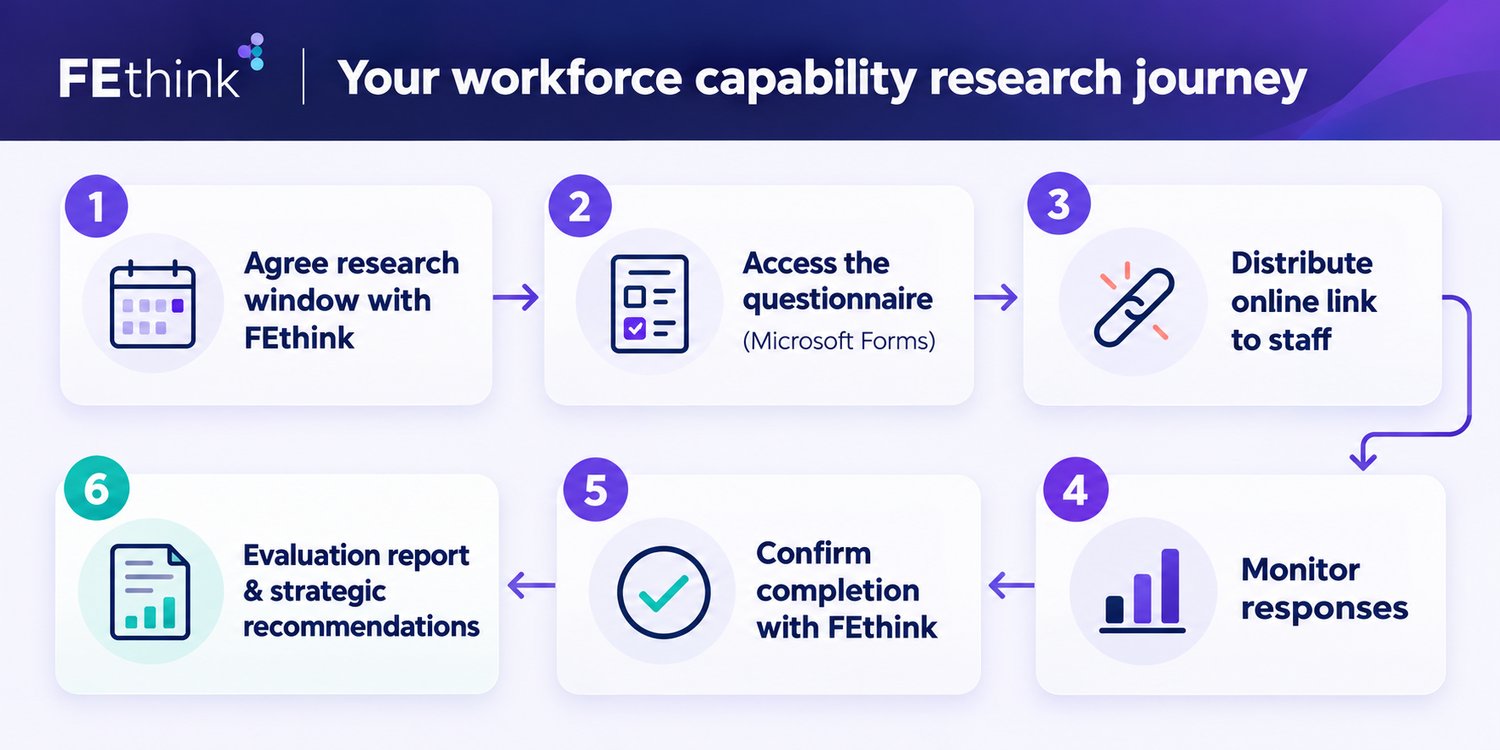
You circulate the questionnaire. We do the analysis and reporting.
£350.00 (inc. VAT) | desk report with recommendations | includes a 45 minute presentation to senior managers
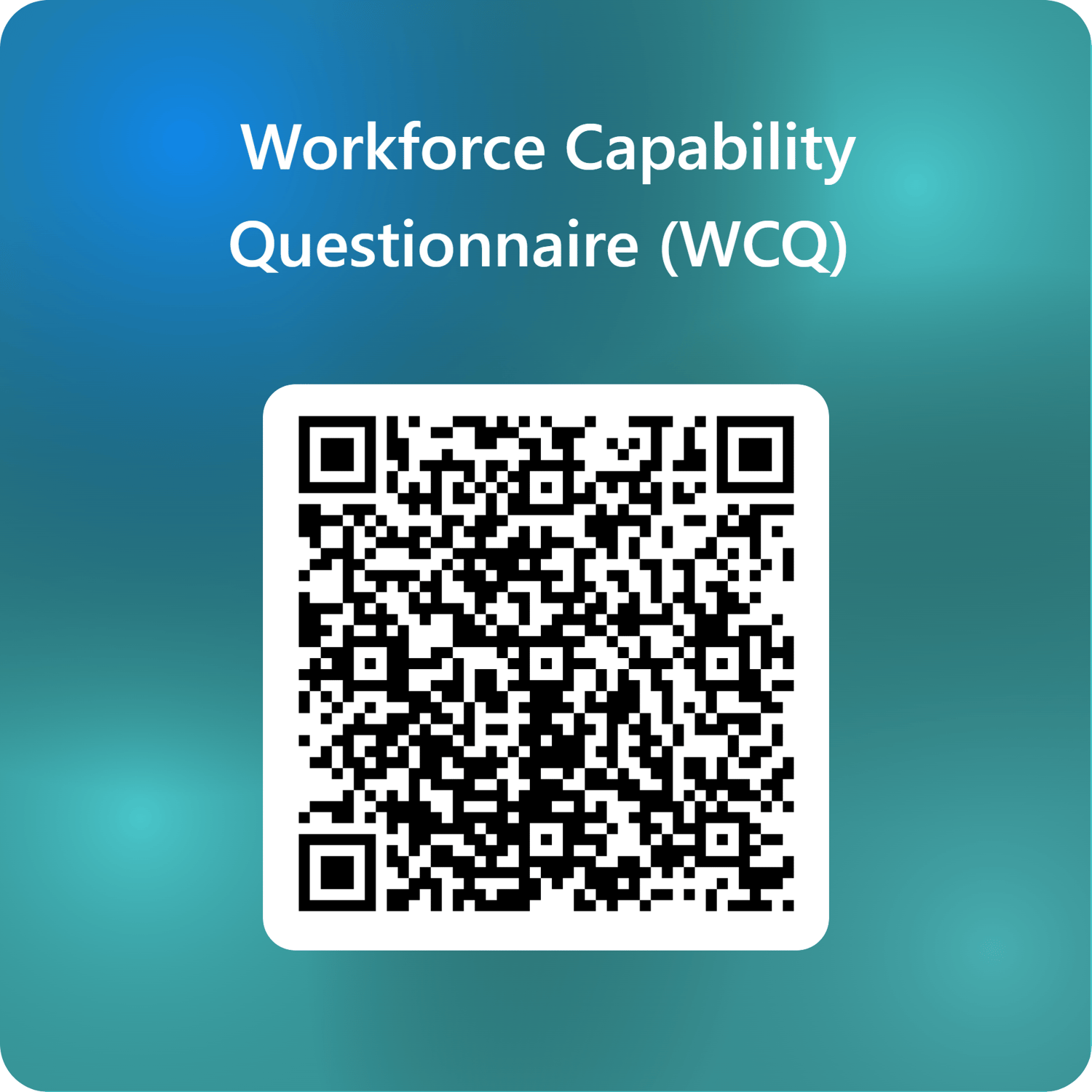
Use your phone to complete the questionnaire
Scan the code to complete the questionnaire, or use the link to share with colleagues https://forms.cloud.microsoft/r/VGWNx5YmSA
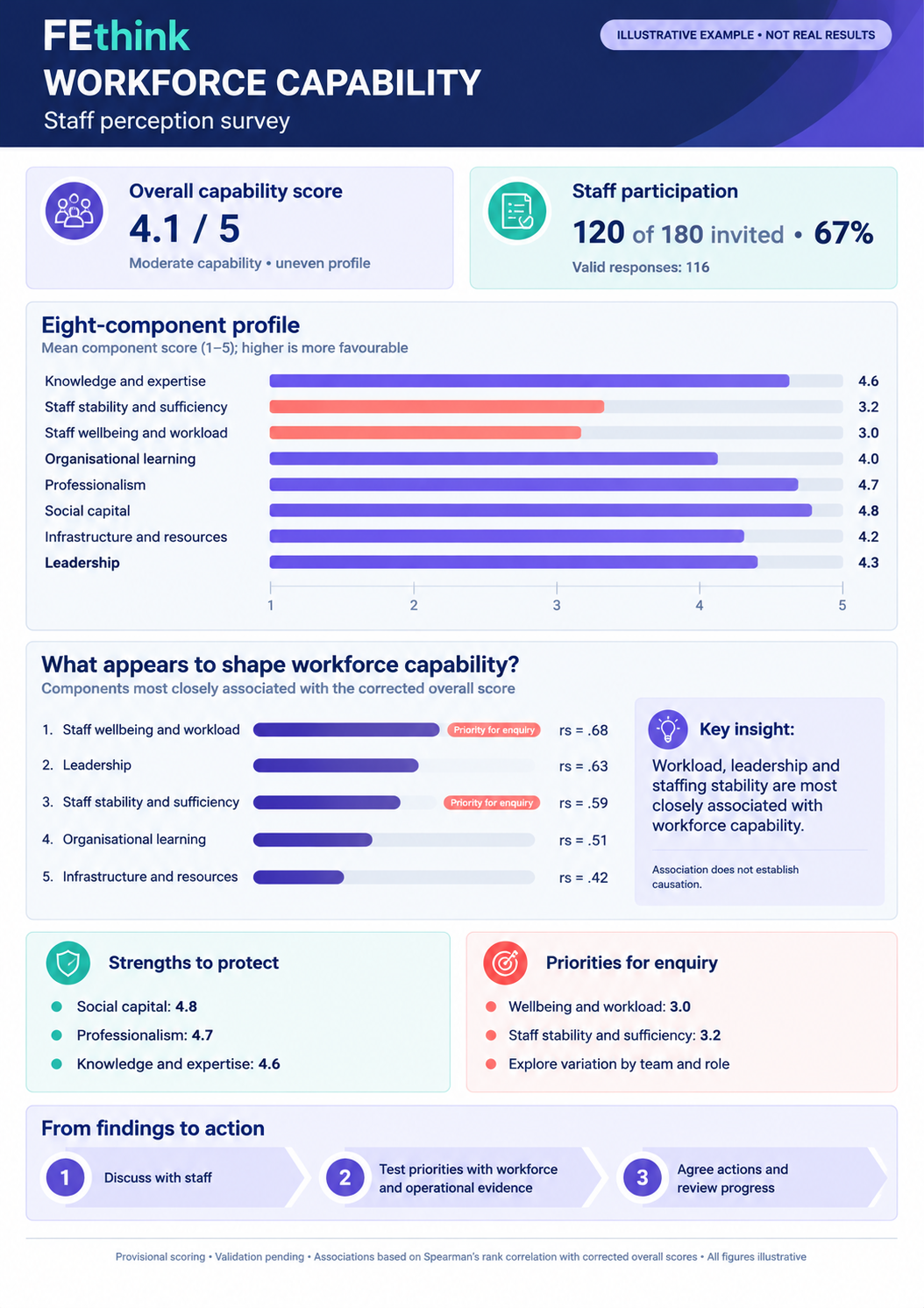
Research corner: Staff perceptions as evidence of workforce capability
Staff perceptions offer evidence about the conditions in which workforce capability is exercised. Employees experience whether expertise is available, workloads are manageable, colleagues provide support and leaders make clear, fair decisions. Their responses can therefore identify strengths and constraints that staffing records alone may miss.
Research supports relationships between subjective assessments and independently measured outcomes. Wall et al. (2004) found positive associations between subjective and objective company performance measures, providing evidence of convergent validity. In UK healthcare, Powell et al. (2014) linked better staff experiences, particularly wellbeing and job design, with lower absenteeism and greater patient satisfaction. International evidence strengthens the case for taking staff feedback seriously. Gallup’s (2024) meta-analysis covered 183,806 work units across 347 organisations and reported an estimated corrected correlation of 0.49 between engagement and composite performance.
Together, these studies suggest there is merit in using staff perceptions as diagnostic evidence and potential predictors of organisational performance and capability.
References:
Gallup. (2024). The relationship between engagement at work and organizational outcomes: Q12 meta-analysis (11th ed.),
Powell, M., Dawson, J., Topakas, A., Durose, J., & Fewtrell, C. (2014). Staff satisfaction and organisational performance: Evidence from a longitudinal secondary analysis of the NHS staff survey and outcome data. Health Services and Delivery Research, 2(50), 1–306. https://doi.org/10.3310/hsdr02500
Wall, T. D., Michie, J., Patterson, M., Wood, S. J., Sheehan, M., Clegg, C. W., & West, M. A. (2004). On the validity of subjective measures of company performance. Personnel Psychology, 57(1), 95–118. https://doi.org/10.1111/j.1744-6570.2004.tb02485.x
