
Managing Behaviour

You make it happen!
Practical approaches that help FE staff establish expectations, build positive relationships and respond confidently when behaviour becomes challenging.
Workshops | Team development | 1:1 coaching
Why behaviour matters
Behaviour isn't just about managing disruption
Effective classroom management is about creating the conditions in which learners can participate, belong and succeed. Research connects positive teacher–learner relationships with stronger engagement and achievement, while classroom-management approaches can improve behavioural, academic and social-emotional outcomes (Roorda et al., 2011; Korpershoek et al., 2016). Clear expectations, predictable routines and consistent responses matter, but so do relationships, motivation and the quality of the learning experience. Good behaviour management is therefore not simply about responding to disruption - it is about designing environments in which positive behaviour is more likely.
References
Korpershoek, H., Harms, T., de Boer, H., van Kuijk, M., & Doolaard, S. (2016). A meta-analysis of the effects of classroom management strategies and classroom management programs on students’ academic, behavioral, emotional, and motivational outcomes. Review of Educational Research, 86(3), 643–680. https://doi.org/10.3102/0034654315626799
Roorda, D. L., Koomen, H. M. Y., Spilt, J. L., & Oort, F. J. (2011). The influence of affective teacher–student relationships on students’ school engagement and achievement: A meta-analytic approach. Review of Educational Research, 81(4), 493–529. https://doi.org/10.3102/0034654311421793




From reactive behaviour management to positive learning cultures
Teacher strategies to support positive behaviour lie on a continuum.
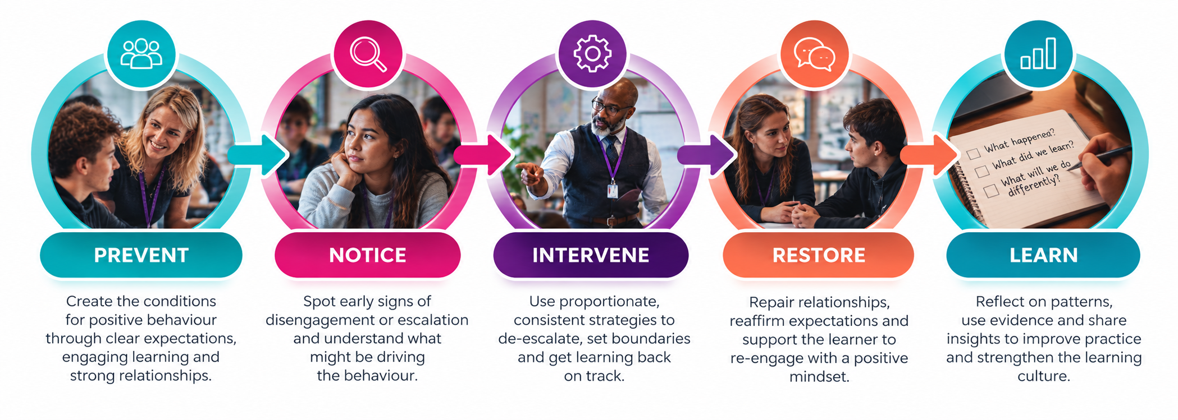
Behaviour rarely begins with the incident that attracts attention. The FEthink model encourages staff to work across the whole behaviour cycle: prevent avoidable problems, notice early signs, intervene before situations escalate, restore learning and relationships afterwards, and learn from what happened. Used consistently, the model turns individual incidents into opportunities for improvement, giving staff a practical framework for deciding when to act, how to respond and what should change next time.

Book one of our training workshops

Workshop 1: Managing Challenging Behaviour
Challenging behaviour can disrupt learning and undermine staff confidence, particularly when expectations and responses are inconsistent.
A practical, scenario-based session exploring boundaries, early intervention and proportionate responses while maintaining professional authority.
Key takeaways:
- Recognise triggers and warning signs.
- Establish clear boundaries.
- Respond confidently and proportionately.
- Restore learning after incidents.

Workshop 2: Building Positive Classroom Cultures
Unclear expectations, weak routines and limited belonging can allow disengagement and low-level disruption to become normalised.
Explore practical ways to build classrooms characterised by clear expectations, positive relationships, participation and shared responsibility for learning.
Key takeaways:
- Establish effective routines.
- Communicate high expectations.
- Strengthen relationships and belonging.
- Build learner responsibility.

Workshop 3: De-escalation and Difficult Conversations
Difficult situations can escalate when staff need to challenge behaviour while simultaneously managing tension and maintaining boundaries.
Practise communication, de-escalation and conversation techniques for responding calmly and confidently when learners become resistant or confrontational.
Key takeaways:
- Recognise escalation early.
- Use language that reduces tension.
- Maintain boundaries calmly.
- Handle difficult conversations confidently.

Workshop 4: Motivating and Re-engaging Learners
Disengagement can appear through poor attendance, withdrawal, limited participation or unfinished work — not simply disruptive behaviour.
Explore what drives motivation and apply practical strategies for reconnecting learners with learning, achievement and future goals.
Key takeaways:
- Recognise causes of disengagement.
- Strengthen motivation and persistence.
- Make learning purposeful and achievable.
- Rebuild momentum through success.