Our mentoring approach

Mentoring through the First 100 Days
Personal support at the moments that matter
Starting to teach in FE is highly individual. New teachers arrive with different occupational backgrounds, previous teaching experience, confidence levels and professional development needs. A common induction programme can provide important knowledge and structure, but it cannot anticipate every challenge a new teacher will encounter.
That is why individual mentoring is built into the First 100 Days programme.
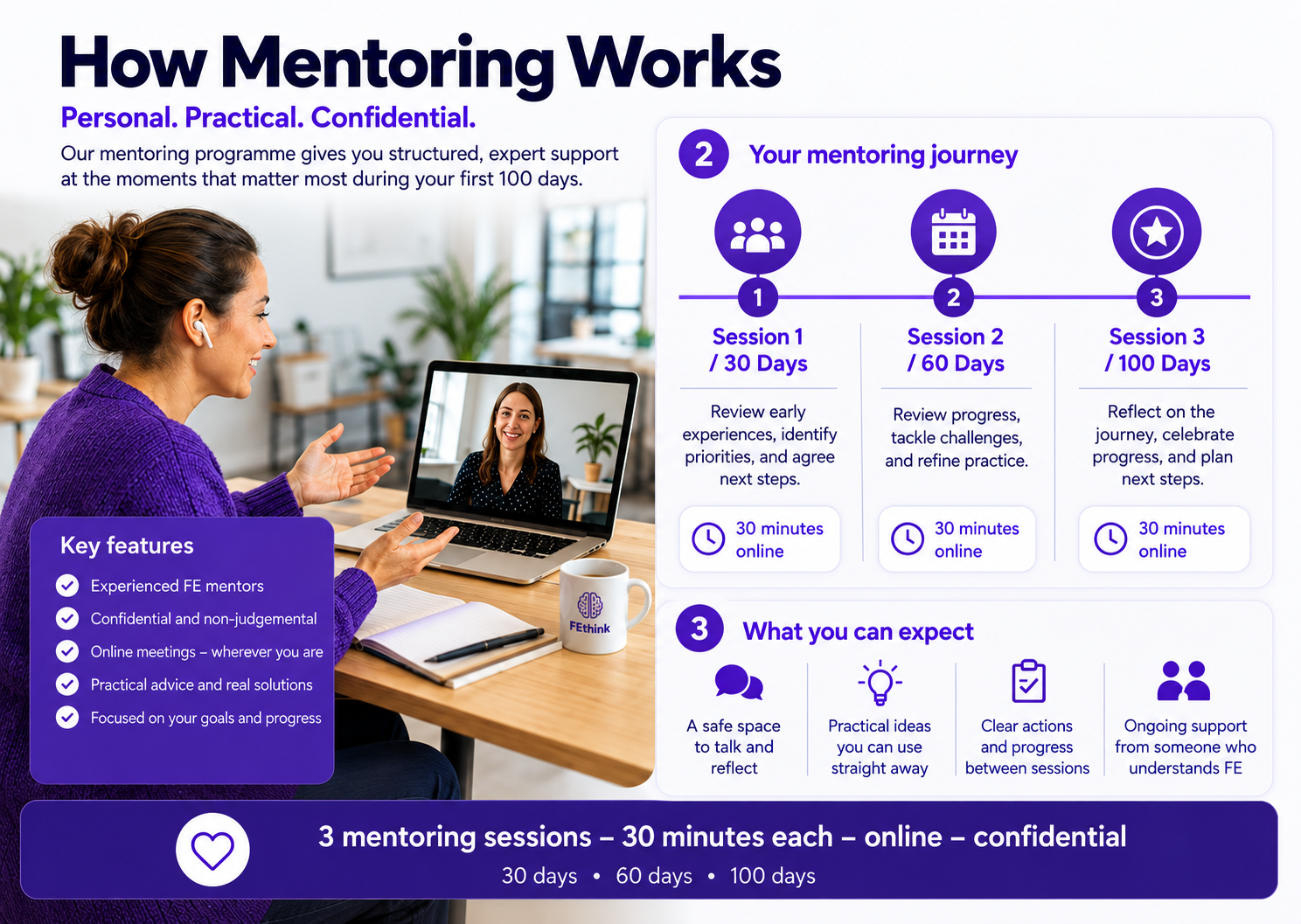
Each participant receives three confidential 30-minute mentoring sessions at Day 30, Day 60 and Day 100. The timing is deliberate. Rather than concentrating support at the beginning, mentoring follows the teacher as their experience develops. By Day 30 they have real experiences to discuss; by Day 60 patterns, strengths and challenges are becoming clearer; and by Day 100 they can reflect on progress and identify what they need next.

The conversations therefore change as the teacher develops:
Day 30 — Settle: review early experiences, identify immediate priorities and agree practical next steps.
Day 60 — Teach: review progress, explore emerging challenges and refine practice.
Day 100 — Grow: reflect on the journey, recognise development and plan the next stage of professional learning.
Mentoring sits alongside the programme's 12 competencies and four outcomes of Confidence, Capability, Connection and Identity. It creates space for participants to make sense of what they are experiencing rather than simply accumulating knowledge about teaching.

Our mentoring principles
1. Developmental, not judgemental
Mentoring is designed to help a new teacher develop, not to assess their performance. The conversation starts with their experience, questions and priorities.
2. Confidential and psychologically safe
New teachers need somewhere they can talk openly about uncertainty, mistakes and difficult experiences without feeling that every conversation is part of formal performance management.
3. Practical and grounded in real experience
Mentoring focuses on what is actually happening in the teacher's work. The aim is not abstract discussion, but practical reflection that leads to something they can try, change or investigate.
4. Teacher-led, but appropriately challenging
The participant brings the issues that matter to them. The mentor listens, questions, challenges assumptions and helps the teacher identify realistic actions rather than simply providing answers.
5. Connected to practice
Mentoring follows the same developmental logic as the wider programme:
Connect → Experience → Learn → Reflect → Act → Test → Reconnect
Teachers experience the realities of the role, reflect on them with someone who understands FE, decide what to do differently, test that response in practice and return with new insight.

6. Responsive to different starting points
An experienced engineer entering teaching faces different challenges from a graduate beginning their first professional role. The mentoring model recognises prior expertise while responding to the individual's emerging needs as an FE teacher.
7. Focused on progress, not perfection
The first 100 days are a period of professional formation. The expectation is not that somebody becomes a fully accomplished teacher in 100 days, but that they can recognise progress, understand their development needs and increasingly take ownership of their practice.
More than three mentoring conversations
The wider support model is deliberately broader than scheduled one-to-one meetings. Participants also benefit from a peer partner, opportunities for action learning around real workplace challenges, access to expert Q&A, and support with CPD planning.
Together, these elements create different forms of support: peers provide everyday connection; mentors provide confidential individual reflection; specialists provide expertise when required; and action learning helps participants solve problems collaboratively.
The result is a mentoring approach designed not to create dependency, but to develop increasingly confident, reflective and self-directed FE professionals.
Why this matters to the organisation
Effective induction needs to do more than familiarise somebody with policies and procedures. It needs to help a new colleague settle, teach, belong and grow.
By combining structured learning with individual mentoring, peer connection, reflection and repeated progress reviews, First 100 Days gives providers a coherent way of supporting new teaching staff while recognising that professional development happens differently for every individual.
Mentoring packages