


Supporting new teachers

Give new teachers the start they need to succeed in Further Education
Practical support that builds confidence, capability and professional identity — from the first day in the classroom.

The First 100 Days is a brand new teacher induction and support programme
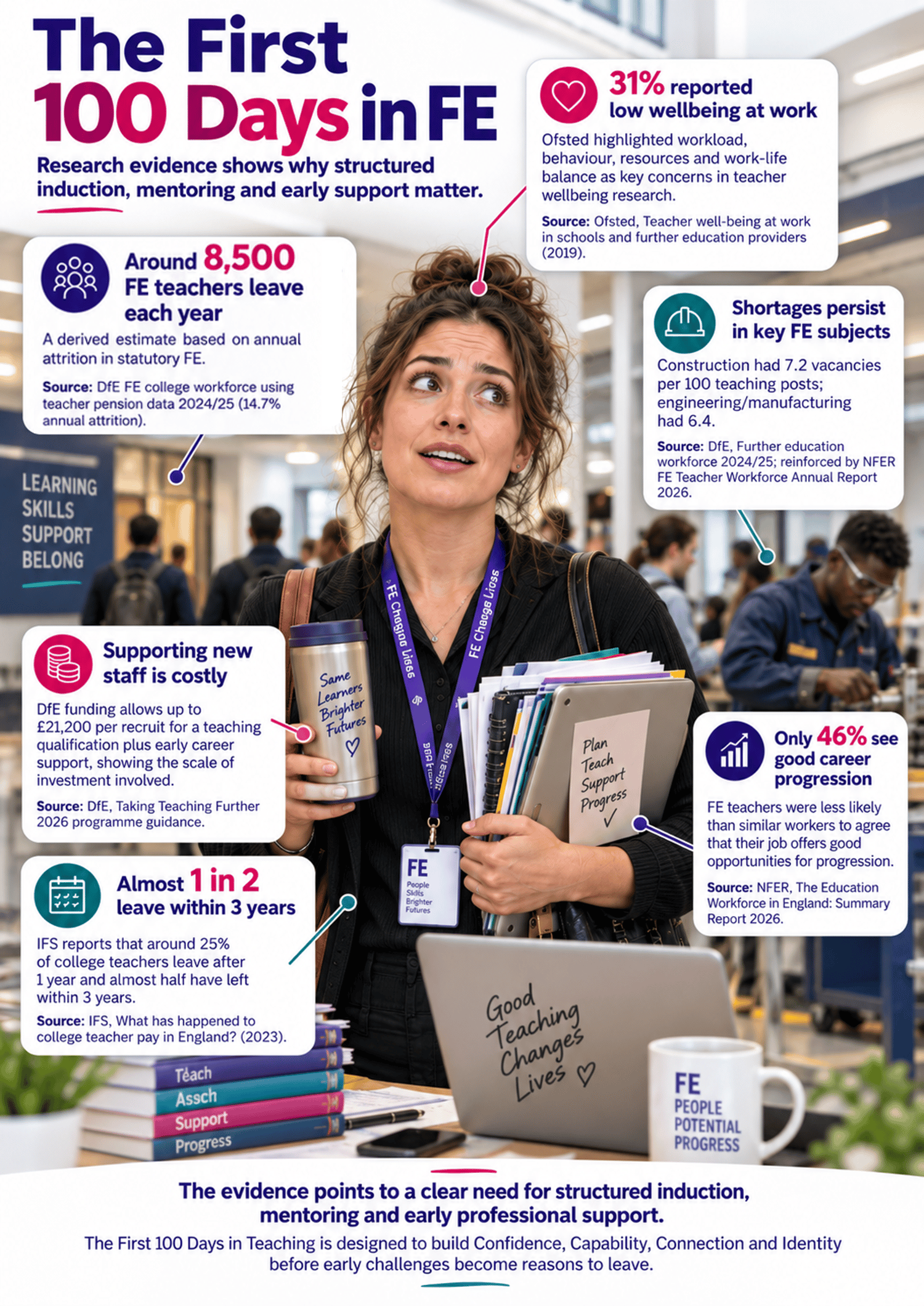
The problem — The first months matter
This establishes the organisational need. New FE teachers and trainers are simultaneously learning to teach, understand their learners, manage behaviour, assess progress and navigate an unfamiliar organisation. Some are also moving directly from industry into teaching.
The solution — becoming a professional teacher
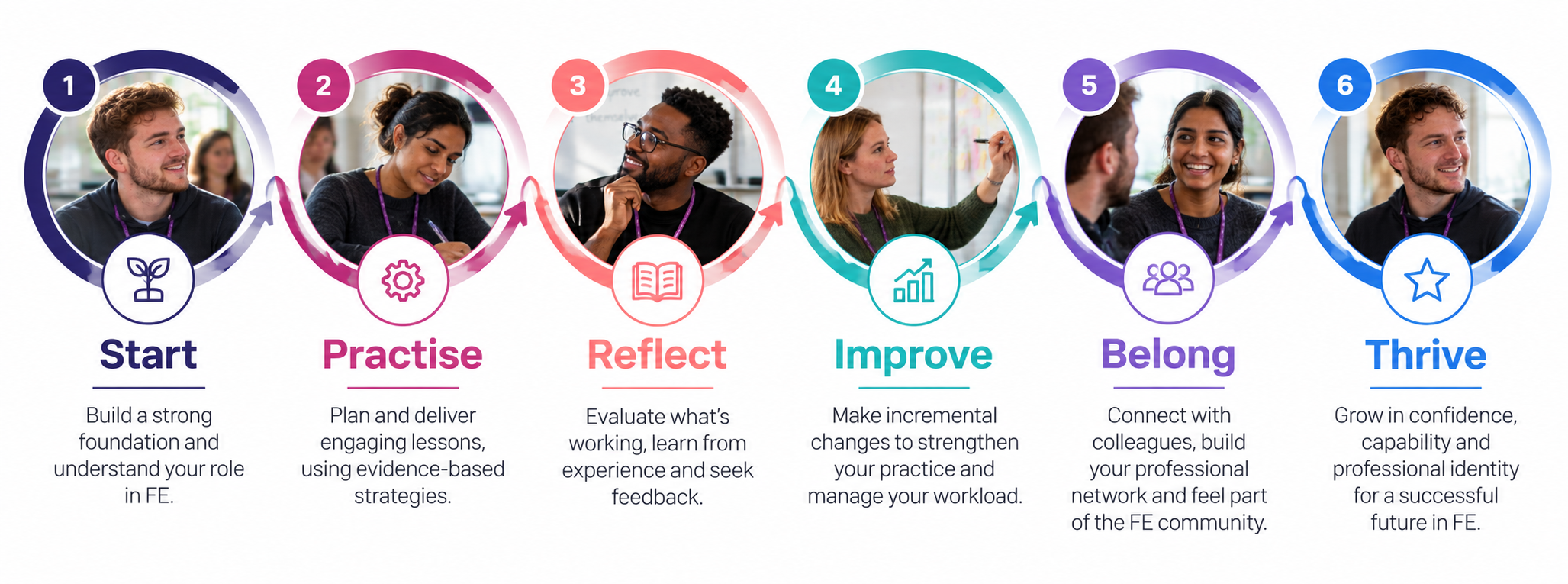
The journey from new teacher to confident FE professional takes time. Our model recognises that development happens through practice, reflection and continuous improvement, supported by the right people and environment. As confidence and capability grow, new teachers develop a stronger sense of belonging — creating the conditions to thrive in FE.
What new teachers actually need to learn

Six key habits - what every teacher should master
Set clear success criteria
Make expectations and intended learning clear.
Establish routines
Create predictable conditions in which learning can happen.
Know your learners
Understand starting points, needs and motivations.
Keep learners active
Design learning that requires participation rather than passive attendance.
Improve every week
Use reflection and feedback to make small, sustained improvements.
Protect your time
Develop sustainable working habits before workload becomes overwhelming.

These six habits are at the centre of the First 100 Days programme

The first 100 days new teacher programme

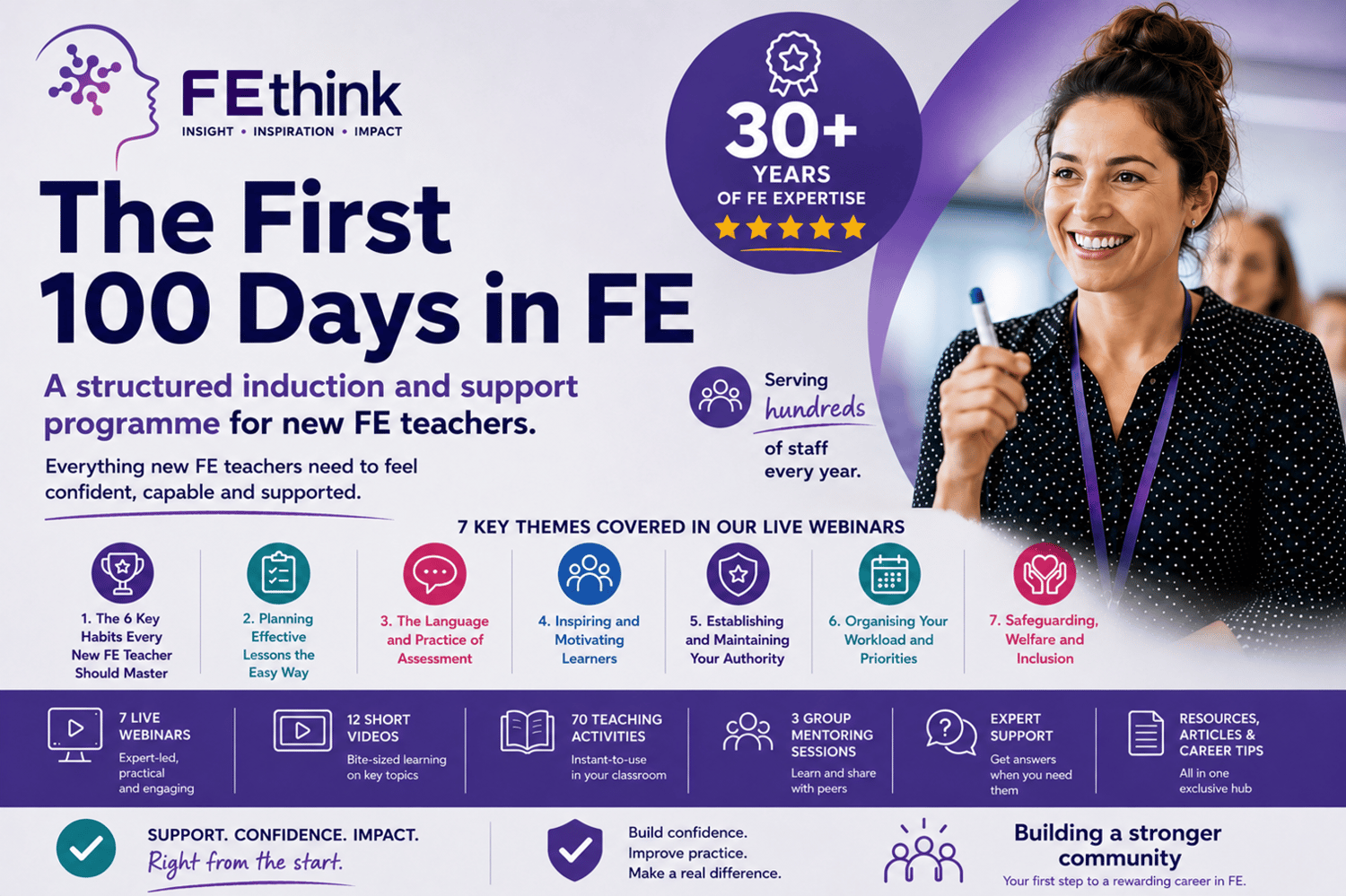
The First 100 Days is FEthink's flagship teacher induction programme.
We have reviewed the research on teacher induction in the UK and internationally, and consulted sector professionals and stakeholders.
The central argument was that new FE teachers need a manageable, developmental framework that reflects the realities of entering the profession, rather than another formal assessment system.
We identified 4 domains and 12 competencies from the literature that we felt were foundational to the experience of new teachers and which would make the difference between thriving and failing in the sector.
Teacher Induction Competency Model (FEthink, 2026)
Domain: Teaching Techniques
Planning Lessons; Engaging Learners; Assessing & Feedback
Domain: Learners and Behaviour
Diagnosing Needs; Supporting Learners; Managing Behaviour
Domain: Policy & Organisation
Being Inclusive; Meeting Standards; Understanding FE Policy
Domain: Being Professional
Reflecting on Practice; Collaborating with Others; Developing Expertise
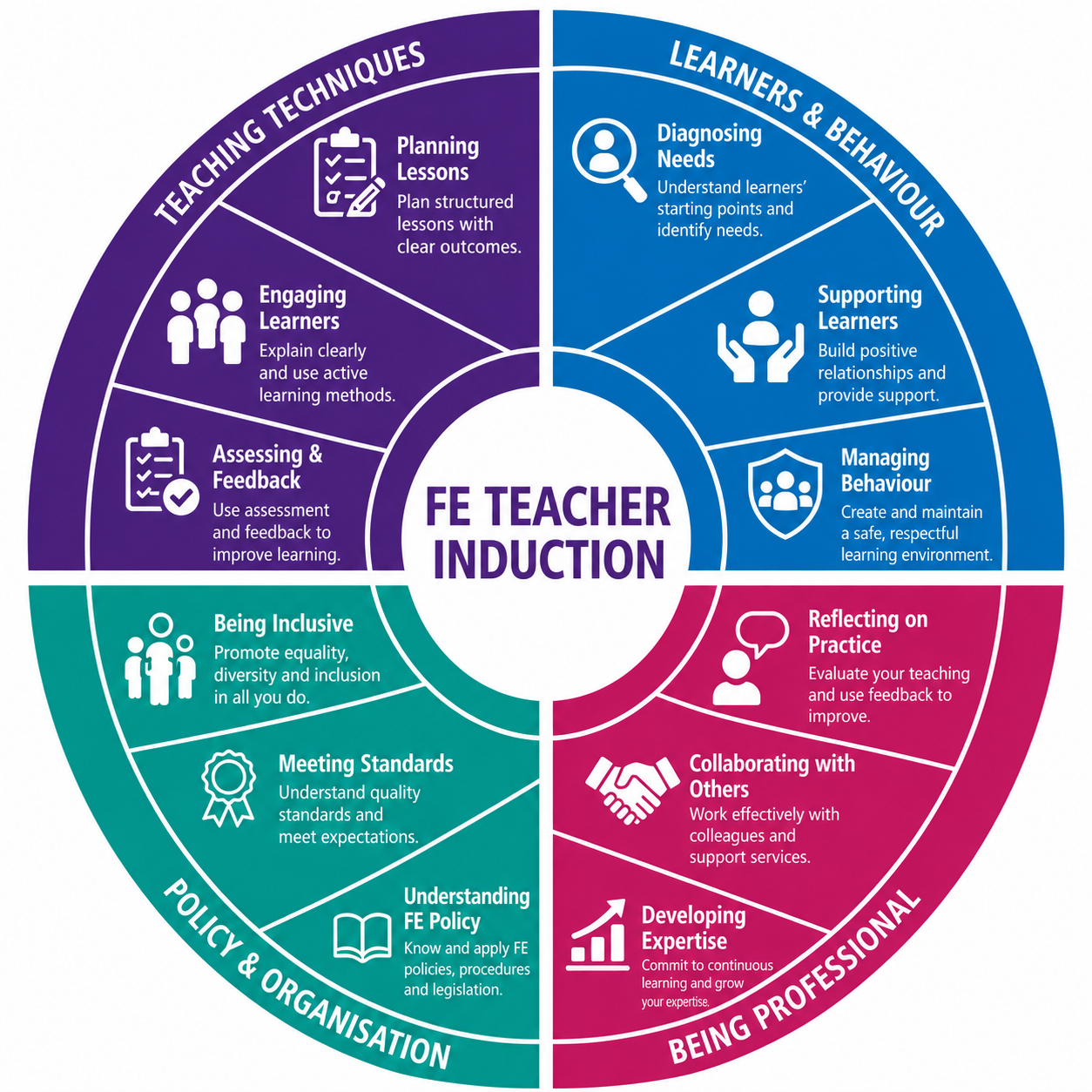
The FEthink induction competency model identifies 12 areas of professional practice that new teachers need to develop during their transition into Further Education. Organised into four domains, the framework brings together the practical demands of teaching, understanding learners, navigating organisational expectations and developing professional identity. Its design deliberately prioritises accessibility and relevance over exhaustive coverage of professional standards.
The competencies provide a common language for self-assessment, mentoring and professional reflection. Rather than judging performance against fixed expectations, they help new teachers recognise emerging strengths, identify development needs and apply learning to everyday practice. Progress is reviewed throughout the first 100 days, creating a structured record of professional development while recognising that teachers enter FE with different experiences, qualifications and starting points.
Benefits:
Simple and relevant: The framework deliberately simplifies the complex expectations of FE teaching into 12 accessible areas relevant to someone entering the profession.
Grounded in professional expectations: It draws conceptually on FE professional standards and the Learning and Skills Teacher apprenticeship standard without attempting to reproduce either framework.
Developmental rather than judgemental: The competencies help teachers identify priorities, reflect on experience and discuss progress with mentors. They are not intended to function as an inspection or performance-management instrument.
Connected to measurable development: Competencies are reviewed at Day 1, 30, 60 and 100, alongside four outcomes: Confidence, Capability, Connection and Identity.
Our framework provides intellectual rigour and a theoretical foundation for our First 100 Days programme.

Take a look at our mentoring packages for new teachers
Book an informal discussion
If you have a teacher retention issue, or find that you are losing too many specialist staff from industry at the start of the year, the First 100 Days Teacher Induction Programme is for you.
Why induction matters
FEthink discusses the evidence on teacher induction in Further Education
Becoming a teacher in Further Education is a distinctive professional transition. Unlike entrants to many other parts of education, new FE teachers and training professionals may arrive with substantial occupational expertise but comparatively little experience of pedagogy. They are therefore not simply learning a new job: they are negotiating what it means to become a teacher while retaining credibility and identity as an occupational specialist.
Esmond & Wood (2017) use the concept of 'dual professionalism' to describe the tension that arises as an occupational expert begins a new career in teaching, in which they are novices. While this concept is an over-simplified explanation of a more complex process of professional identity formation, it nevertheless illustrates how experienced professionals can face barriers as they navigate and interpret a new work culture.
Orr and Simmons (2010) describe a different dilemma that new teachers also face, using the concept of dual identities, in which a new teacher experiences dissonance when they must simultaneously balance the expectations of being an employed teacher - which carries notions of competence and authority - with the realities of being a trainee teacher who is learning and experimenting.
This process of identity formation is strongly shaped by the workplace into which the new teacher enters. Bathmaker and Avis (2005) found that professional formation did not automatically result from placement in an FE community of practice; some trainees instead experienced marginalisation and alienation. Their subsequent work illustrates the adaptation required as trainees encounter the cultures, expectations and learner relationships of FE, where the perception of belonging is crucial (Bathmaker & Avis, 2007).
This suggests that induction needs to create deliberate opportunities for participation, relationships, reflection and professional belonging, rather than assuming these develop naturally. The transition also extends beyond initial teacher training. Avis and Bathmaker’s (2009) longitudinal work followed FE trainees into lecturing and demonstrates that becoming an FE professional continues as teachers encounter the realities of practice.
Research into practising FE teachers likewise shows professional identity being continually formed and re-formed through interactions with learners, previous occupational experience and changing organisational conditions.
For vocational entrants in particular, effective induction therefore has to connect occupational expertise with pedagogical expertise. New teachers must learn how to plan learning, establish expectations, motivate diverse learners, assess progress and manage workload while developing confidence in their new professional role. Current DfE guidance reflects the continuing importance of supported entry routes into FE, including learning while employed and mentoring during early development.
These processes help explain why induction needs to extend beyond an initial orientation to policies, systems and procedures. New teachers need opportunities to experience teaching, make sense of those experiences, develop pedagogical knowledge, receive feedback, test different approaches and gradually build confidence in themselves as teachers. This is an important rationale for the First 100 Days in FE programme. Our 12 competencies provide a practical structure around that development: teaching techniques; understanding learners and behaviour; navigating policy and organisation; and becoming a professional.
The programme's wider impact measures of Confidence, Capability, Connection and Identity recognise that successful induction is not simply about whether somebody can perform individual teaching tasks. In particular, Identity asks a deeper question: is the individual beginning to see themselves - and be recognised by others - as an FE professional?
The aim is therefore not to replace one identity with another. It is to help them add teaching to who they already are, while providing legitimate space to remain a learner of teaching during the transition. That distinction is important. A new FE teacher can simultaneously be an experienced occupational professional, an employed teacher with real responsibilities, and a developing practitioner who still needs structured opportunities to learn.
Taken together, the FE literature points towards induction as professional formation rather than organisational orientation. The strongest model is consequently not a one-day introduction followed by isolated training. New teachers need sustained opportunities to practise, receive feedback, reflect, connect with colleagues and progressively assume their identity as FE professionals. That provides a strong evidence base for focusing induction simultaneously on confidence, capability, connection and professional identity.
References
Avis, J., & Bathmaker, A.-M. (2009). Moving into practice: Transitions from further education trainee teacher to lecturer. Research in Post-Compulsory Education, 14(2), 203–217.
https://doi.org/10.1080/13596740902921638
Bathmaker, A.-M., & Avis, J. (2005). Becoming a lecturer in further education in England: The construction of professional identity and the role of communities of practice. Journal of Education for Teaching, 31(1), 47–62. https://doi.org/10.1080/02607470500043771
Bathmaker, A.-M., & Avis, J. (2007). ‘How do I cope with that?’ The challenge of ‘schooling’ cultures in further education for trainee FE lecturers. British Educational Research Journal, 33(4), 509–532. https://doi.org/10.1080/01411920701434037
Esmond, B., & Wood, H. (2017). More morphostasis than morphogenesis? The ‘dual professionalism’ of English Further Education workshop tutors. Journal of Vocational Education & Training, 69(2), 229–245. https://doi.org/10.1080/13636820.2017.1309568
Orr, K., & Simmons, R. (2010). Dual identities: The in-service teacher trainee experience in the English further education sector. Journal of Vocational Education & Training, 62(1), 75–88. https://doi.org/10.1080/13636820903452650
